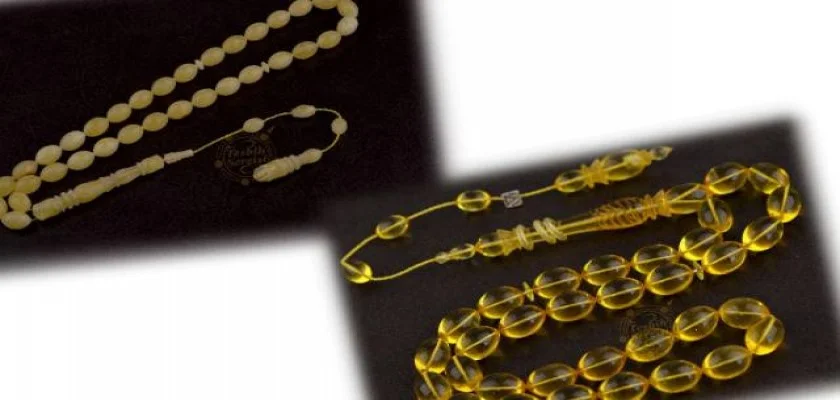
What Are the Main and Intermediate Parts of a Prayer Bead?
Prayer beads, an instrument of worship, are found not only in Islam but also in Christianity, Judaism, and Far Eastern religions. In Catholicism in Europe, the 64-bead ones used by priests and nuns represent the crucifixion of Jesus Christ. They are considered a complementary part of religious attire. In Orthodoxy, they are used as a means of occupying oneself. The Hindus were the first to use a prayer tool, designed in different ways and for different purposes in every religion and community, in 800 BC. In Turkish culture, different meanings are attributed according to the material used and the craftsman who made it. Each bead represents one of the 99 names of Allah, and it also helps us keep track of repetitions of phrases like Allahu Akbar, Alhamdulillah, and Subhanallah after prayers. The beads, called 'habbe,' which are the main components of prayer beads, are beads with holes in the middle, made in various shapes. While the beads made for use have a diameter of 4-11 mm, those made for collection purposes have larger beads. These small, beaded ones, called 'Zenne - Women's Prayer Beads,' are generally designed in spherical, round, ellipsoidal, cylindrical, and turnip shapes.
What Are the Uses of Prayer Beads?
In Islam, amber prayer beads, used as an instrument of worship, are used for the remembrance of God's name. Those made from different materials and types are also used for collection purposes. They symbolize the symbols of the Crescent, Mevlevi, and Bektashi orders. Also accepted among the public as a symbol of the 'külhanbeylik' (a type of traditional street tough), prayer beads are also used as an accessory. In Far Eastern religions, they are considered a meditation tool and are known to be used for relieving stress and relaxation. Additionally, they are specially produced in multi-faceted crystal designs and various aesthetic forms. The 'nişane' and 'pul' pieces, also called 'müezzin,' consist of two small, flat, lentil-shaped beads. The 'nişane' (stopper) piece hanging outwards is placed after the 33rd and 66th beads in prayer beads with 99 beads. In prayer beads consisting of 33 beads, it is placed after the 5th bead, signifying the 5 pillars of Islam. Amber prayer beads, which facilitate counting by ensuring the repetition of religious phrases, consist of habbe, nişane, imame, düğümlük, ara taneler, sikke, hatime, çivi, and kampçı sections.
www.tesbihsergisi.com