
Finite Element Method
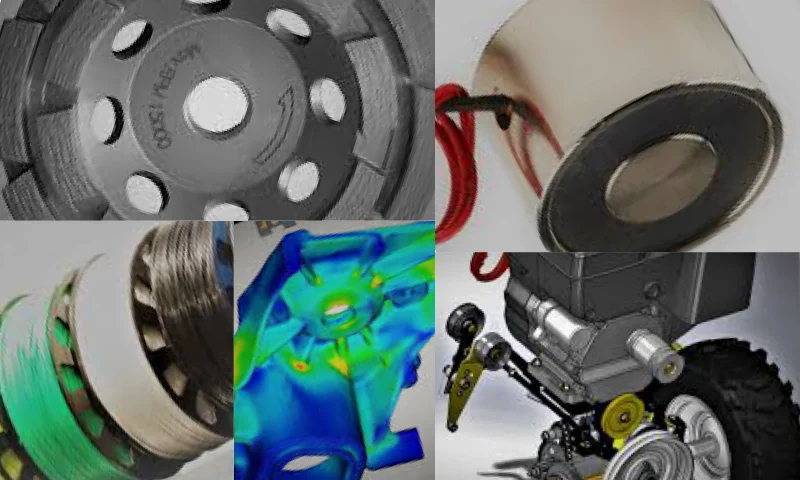
Applications of the Finite Element Method
The Finite Element Method (FEM) is a numerical technique used to perform finite element analysis (FEA) of any physical phenomenon. You can examine our website for more detailed information on the use of this professional method. It is necessary to use mathematics to comprehensively understand and measure any physical phenomenon, such as structural or fluid behavior, thermal transport, wave propagation, and the growth of biological cells. Most of these operations are described using partial differential equations (PDEs). However, for a computer to solve these PDEs, numerical techniques have been developed in recent decades, and one of the leading ones today is the finite element method.
Finite Element Solution Process
The finite element method began with significant promise in modeling various mechanical applications related to space and civil engineering. The applications of the finite element method are now beginning to reach their potential. One of the most exciting prospects is its application in coupled problems such as fluid-structure interaction, thermomechanics, thermochemical, thermochemical-mechanical problems, biomechanics, biomedical engineering, piezoelectric, ferroelectric, and electromagnetic. The set of equations and the solution process vary depending on the problem (thermal, mechanical, linear, nonlinear) and the software used to compute it. However, the general structure is common to all finite element methods:
● Divide the structure into smaller elements by creating a mesh.
● Combine the elements at the nodes by applying the necessary contacts and boundary conditions between different model components to form a system of equations that approximates the actual solution.
● Solve the system of equations using computational resources.
● Post-process the results to calculate the desired quantities (e.g., stress, displacement, temperature) for the entire domain. The benefits of FEA provide a visual representation of stress or temperature gradients throughout the part and allow the designer to quickly analyze changes in the product or process.